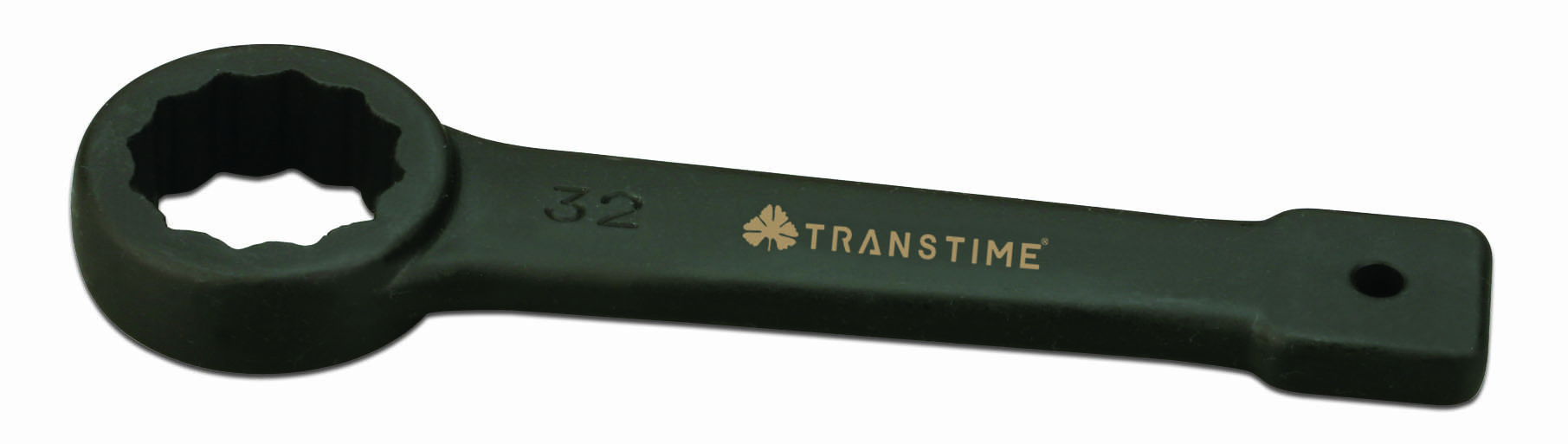
If you source heavy-duty hand tools for industrial maintenance, construction, or flange work, you have almost certainly seen the same tool sold as a slugging wrench, a striking wrench, a slogging wrench, or a hammer wrench. The overlapping names cause real confusion for buyers and importers. This guide explains what these wrenches are, whether the terms actually describe different tools, how ring (box-end) and open-end types differ, and why the steel and heat treatment matter more than most catalogues admit. As a manufacturer of slugging wrenches, our goal here is to help you specify and use them correctly.
What is a slugging (striking) wrench?
A slugging wrench is a short, thick, single-ended wrench built to be hit. Instead of a long handle for leverage, it has a stubby, reinforced body ending in a heavy striking face (an "anvil" or striking pad). You fit the head over the nut or bolt and drive the wrench with hammer blows on that face, converting impact into rotation. This lets one operator apply — in short, controlled bursts — far more breakaway or seating torque than a person could ever generate by hand.
These tools exist because ordinary combination wrenches and even long breaker bars run out of room and out of muscle on the largest fasteners: structural steel connections, heavy machinery, ship and offshore work, pressure-vessel and pipe flanges, mining and crushing equipment, and any joint that has corroded or seized in place. A slugging wrench is the standard answer where fasteners are big, access is tight, and the required torque is high.
"Slugging" vs "striking" vs "slogging": is there a difference?
For practical purposes, slugging, striking, slogging, knocker, and hammer wrench are used interchangeably across the industry. Major European and global brands list the identical DIN-standard tool under several of these names, and the defining feature is always the same: a short body with a striking end made to be hit with a hammer.
Some suppliers do draw a fine distinction — describing a "striking" wrench with a squarer, heavier handle intended mainly for tightening large flange fittings, and a "slugging" wrench with a flatter handle used more for breaking fasteners loose. This distinction is not applied consistently, and it is not defined by any standard, so we treat it as marketing nuance rather than a real category split. When you are sourcing, do not assume two quotes describe different tools because one says "striking" and the other says "slugging." Match them by type (ring or open-end), profile, drive size, standard, and material instead of by name.
Ring (box-end) vs open-end types
There are two main forms, and the choice affects both strength and access:
- Ring / box-end slugging wrench. The head fully encircles the fastener, usually with a 12-point profile and an offset (cranked) neck. Because the ring wraps all the way around the hex, it grips more corners, spreads load, and resists spreading open under high torque. This is the stronger, safer choice for the heaviest tightening and breakaway work, and it is the type least likely to slip off or round a corner. The offset also lifts the striking face clear of the surface so you can swing at it cleanly.
- Open-end slugging wrench. The head is an open U that slides onto the flats from the side. It cannot grip as many corners as a ring, so it is used at somewhat lower relative torque, but it is indispensable where the fastener cannot be accessed from the end — for example on pipework, unions, and flange bolts where a pipe or fitting passes through the fastener line.
A common workflow is to break a joint loose or run it down with the open-end wrench where access demands it, then apply final torque with the box-end where the connection allows.
Material and heat treatment: why toughness beats hardness
This is the part that separates a safe slugging wrench from a dangerous one, and it is where a manufacturer's perspective matters most. A slugging wrench is an impact tool: every blow sends a shock wave through the head. If the steel is too hard and brittle, the striking face can mushroom and shed metal chips, or the head can crack and fail — potentially throwing fragments at the operator.
For that reason, quality slugging wrenches are drop-forged from tough alloy steels — typically chrome-vanadium (Cr-V) or chrome-molybdenum (Cr-Mo) grades — and then heat treated to a balanced hardness rather than the maximum. The goal is a wrench that is hard enough to hold its jaw dimensions and resist wear, yet tough enough to absorb repeated hammer blows without cracking or chipping. Forging (rather than machining from bar) aligns the grain flow around the head and gives the strength-to-weight the tool needs. In short, a good slugging wrench is deliberately not as hard as it could be — that reserve of toughness is a safety feature, not a shortcut.
When comparing suppliers, ask about the base alloy, whether the body is forged, and how the striking face is treated. A cheap wrench made from under-specified steel may look identical in a photo and fail on the third or fourth hard strike.
How to use a slugging wrench safely
Slugging wrenches are safe and effective when used as intended. The main hazards — mushroomed faces, flying chips, and miss-strikes — come from misuse. Recommended practice:
- Seat the wrench fully on the fastener so the head is square and bearing on the flats or corners before you strike.
- Strike the designated face squarely with a suitably heavy hammer. A dead-blow or soft-face hammer (or a heavy soft mallet) reduces rebound and metal-on-metal chipping compared with a hardened steel hammer, and gives more controlled energy transfer.
- Start with lighter blows and build up. Begin gently and increase force gradually rather than swinging at full power immediately — this protects both the fastener threads and the tool.
- In flammable or explosive atmospheres (oil and gas, chemical plants, refineries), use certified non-sparking striking wrenches made from aluminium-bronze or beryllium-copper alloys, and matching non-sparking hammers.
- Do not exceed the tool's capacity. Never add cheater pipes, never use a wrench with a mushroomed or cracked striking face, and do not use it far outside its intended fastener range. Inspect the striking face and head before use and retire any tool showing cracks or heavy deformation.
- Wear eye protection and gloves, and keep hands and bystanders clear of the swing and strike zone.
Standards and typical sizes
Two German DIN standards govern the common heavy-duty forms, and most reputable makers build to them so tools are broadly interchangeable between suppliers:
| Type | Standard | Profile | Notes |
|---|---|---|---|
| Ring / box-end slugging wrench | DIN 7444 | Typically 12-point, offset | Highest-strength option for heavy tightening and breakaway |
| Open-end slugging wrench | DIN 133 | Open U, 15° head | For side access where a ring cannot fit over the fastener |
Slugging wrenches are made across a wide range of large sizes. Our own 12-point box-end slugging wrenches cover roughly 24 mm to 115 mm (about 1" to 4-1/2" in inch sizes), and our open-end slugging wrenches run from about 17 mm to 75 mm. Because the exact size steps, dimensions, and item numbers vary by type, always confirm the fastener size against the specific spec table for the tool you are ordering.
When should you choose a slugging wrench?
Reach for a slugging wrench when the fastener is too large or too tight for conventional wrenches, when you need controlled high torque in a confined space, or when a joint must be seated or broken with impact rather than steady pull. Typical cases include large flange and structural bolting, heavy plant and machinery maintenance, shipbuilding and offshore, and any environment where seized fasteners are routine. Choose the box-end (DIN 7444) type as the default for maximum strength, and add open-end (DIN 133) wrenches for the positions where a ring simply cannot reach.
Source slugging wrenches from the manufacturer
Transtime Tools manufactures both box-end (12-point) slugging wrenches and open-end slugging wrenches, forged from tough alloy steel and heat treated for impact service. If you are an importer, distributor, or industrial buyer and want full size charts, material data, and OEM options, request a quote or contact our team — we are happy to help you specify the right tool for the job.