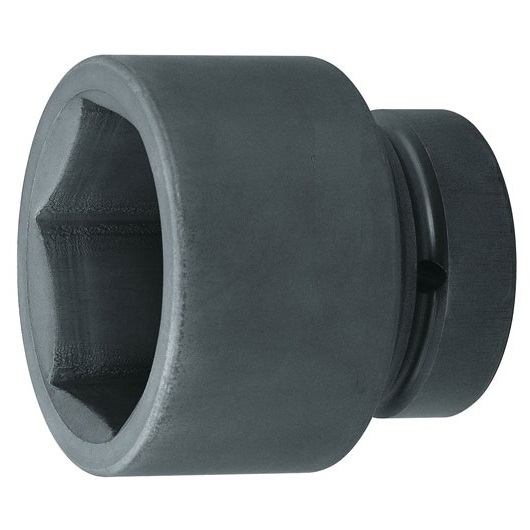
Quick answer: Hand tool hardness is measured on the Rockwell C scale (HRC), and for wrenches and sockets the useful range generally sits in the high-30s to mid-50s HRC — not at the top of what steel can reach. A wrench or socket that is too hard becomes brittle and can crack or shatter under shock load; one that is too soft bends, rounds off, and wears quickly. The right HRC number depends on the tool: hand-driven wrenches and sockets are heat treated harder than impact sockets, which are deliberately kept a little softer and tougher so they can absorb the hammering of an impact wrench without cracking. As a manufacturer, choosing and holding that target hardness through heat treatment is one of the most important — and least visible — quality decisions we make.
What is HRC, and why hand tools use it
HRC stands for Rockwell hardness, scale C — one of several Rockwell scales used to grade metal hardness, standardized under ASTM E18 (Standard Test Methods for Rockwell Hardness of Metallic Materials). The test presses a diamond cone into the metal under a fixed load and measures how deep it penetrates; a shallower indentation means a harder material and a higher HRC number. It is the standard way the hand tool industry specifies and checks the heat treatment of wrenches, sockets, and similar forged steel parts, because it is fast, non-destructive on a sample basis, and directly tied to the microstructure the heat treater is trying to achieve.
Why hand tools aren't hardened to the maximum
Hardness and toughness pull in opposite directions. Pushed to very high hardness, steel resists wear and holds a sharp edge or precise dimension extremely well — but it also becomes more brittle, meaning it has less ability to flex or absorb a shock without cracking. A wrench or socket that is hard enough to hold its jaw dimensions but brittle will eventually crack under a hard pull, a hammer blow, or an impact wrench's hammering action, sometimes throwing fragments. Heat treaters therefore aim for a balanced hardness: hard enough to resist wear and permanent bending, but with enough retained toughness to absorb the shocks the tool will actually see in service. This is why quality tools are described as being tempered to a specific range rather than simply "as hard as possible."
Typical hardness ranges by tool type
Exact numbers vary by manufacturer, standard, and tool type, and a buyer should always confirm the figure quoted for a specific product rather than assume a single number applies everywhere. That said, industry discussion of the ASME B107 series (the North American standard covering wrenches, sockets, and their attachments) points to broadly similar bands across mainstream hand tools:
| Tool type | Typical HRC band | Why |
|---|---|---|
| Hand wrenches (open-end, box, combination) | Roughly high-30s to mid-50s HRC | Balances edge/jaw retention against the toughness needed for hand-applied torque and occasional shock loading |
| Hand sockets | Similar high-30s to mid-50s HRC range | Needs to hold precise internal dimensions under torque without cracking on a stuck fastener |
| Impact sockets & impact accessories | Generally toward the lower end of that range, often cited around high-30s to high-40s HRC | Made from chrome-molybdenum steel and tempered softer than hand-tool grade so they can absorb repeated hammer-blow loading from an impact wrench instead of cracking |
The pattern to remember is directional, not a precise universal number: the more shock loading a tool is designed to take, the more its heat treatment favors toughness over raw hardness.
How heat treatment gets you there
Reaching a target hardness is a controlled sequence, not a single step. After forging, the part is heated to a specific temperature and quenched (rapidly cooled, typically in oil) to harden the steel — at this stage the material is at or near its maximum hardness, but also at its most brittle. It is then tempered: reheated to a lower, carefully controlled temperature and held there before cooling again. Tempering trades away some peak hardness in exchange for toughness, and the tempering temperature and time are what tune the final part to land inside its target HRC window. Skipping or rushing tempering is one of the most common ways a tool ends up too hard and too brittle for service.
Chrome-vanadium vs chrome-molybdenum
Base alloy matters as much as the heat treatment recipe. Chrome-vanadium (Cr-V) steel is a common choice for hand wrenches and hand sockets, offering a good balance of strength and machinability at hand-tool hardness levels. Chrome-molybdenum (Cr-Mo) steel is generally preferred for impact sockets, slugging wrenches, and other tools built to absorb repeated impact, because it retains better toughness at the somewhat lower hardness those tools are tempered to. Choosing the wrong alloy for the job — for example using hand-tool-grade Cr-V hardened the normal way in a part meant for impact use — is a common cause of the "chrome socket shatters on an impact wrench" failures reported by mechanics.
What actually goes wrong at each extreme
- Too hard / under-tempered: the tool holds its shape well but is brittle. Under shock loading (a hammer blow, an impact wrench, a sudden snap on a stuck bolt) it can crack or shatter rather than deform, which is also a safety hazard from flying fragments.
- Too soft / over-tempered or under-hardened: the tool bends, the jaws spread, or the drive corners round off under normal torque, and it wears out quickly. It will not crack, but it also will not hold up to real work.
How manufacturers verify hardness
Reputable hand tool manufacturers check hardness in-house on finished or in-process parts using a Rockwell hardness tester, sampling production batches against the target range for that tool and standard. This is a routine part of quality control alongside dimensional and, for some tool categories, impact or proof-load testing. When sourcing, it is reasonable to ask a supplier what hardness range they target for a given tool, what alloy it is made from, and whether they can share in-house test records.
Sourcing checklist
When specifying wrenches, sockets, or accessories, ask the manufacturer: (1) what standard the tool is built to (ASME B107, DIN, ISO); (2) the base alloy (Cr-V or Cr-Mo); (3) the target hardness range and how it is verified; and (4) whether the tool is rated for hand use only or for impact/power tool use. A manufacturer that forges and heat treats in-house should be able to answer all four without hesitation.
See how we control hardness and heat treatment
Transtime Tools forges and heat treats wrenches, sockets, and accessories in-house, with in-house hardness testing on our own production. You can read more about our process on the manufacturing capabilities page, and see the standards we build to on our standards & certifications page. If you need a specific hardness spec, alloy, or test documentation for a project, request a quote or contact our team and we'll confirm the details against the standard you need.