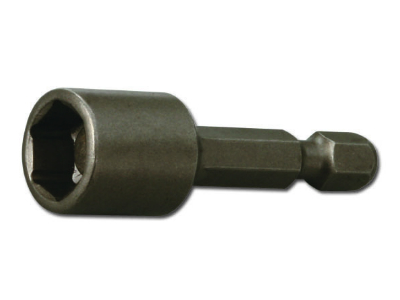
A magnetic nut setter is a short hex-drive tool with a magnet built into its tip that holds a nut or hex-head bolt in place while an impact driver or drill spins it onto a fastener. The magnet keeps the fastener centered and captive — even one-handed, overhead, or in a spot you can't hold it with your fingers — which is why magnetic nut setters have become a standard accessory for driving hex-head screws, cladding, decking, and light-gauge steel connections with a power tool instead of a hand wrench and socket. This guide covers how magnetic nut setters work, how they compare to a standard socket, common sizes, and when to reach for one. As a manufacturer of magnetic nut setters, our goal is to help you specify and use them correctly.
What is a magnetic nut setter?
A magnetic nut setter looks like a stubby hex bit: a power-tool shank at one end and a hexagonal bore at the other end, sized to grip a specific nut or bolt head. Inside that bore sits a strong magnet, usually retained by a brass or steel sleeve, that pulls the fastener in and holds it square to the tool while you drive it home. Because the fastener is captured on the tip rather than held by hand, you can start a nut in a hard-to-reach spot, on a ladder, or overhead without it dropping or wobbling off-axis.
How it works with an impact driver
Most magnetic nut setters use a 1/4-inch hex shank, the same shank size as common driver bits, so they chuck straight into the quick-release collet of an impact driver, drill/driver, or right-angle drill with no adapter needed. That is what makes them useful on production and field work: instead of swapping to a socket and ratchet, you keep the same power tool in hand for driving screws and setting nuts, switching bits in seconds. Quality nut setters are made from chrome-vanadium steel and are rated for impact use, so the shank and hex bore hold up to the torque spikes an impact driver produces instead of cracking or rounding out the way a light-duty adapter might.
Magnetic nut setter vs. a standard socket
| Tool | Holds fastener hands-free | Drives directly in an impact driver | Best for |
|---|---|---|---|
| Magnetic nut setter | Yes (built-in magnet) | Yes (1/4" hex shank) | Fast, one-handed nut/bolt setting in awkward positions |
| Standard socket | No | Only with a hex-to-square adapter | High-torque work, ratchet or impact wrench use |
| Screwdriver-style nut driver | Sometimes (some have magnets) | No — fixed handle, hand use only | Light hand-driving of small nuts |
Fit matters as much as the magnet. A nut setter's hex bore should seat fully over the flats of the fastener before you pull the trigger — if it is canted or only partly engaged, the drive can slip and round the corners, the same failure mode as a worn socket. Some nut setters use a plain hex bore that bears on the corners like a socket; others use a lobed or multi-point bore designed to load the flats rather than the corners, which several manufacturers market as a way to cut down on rounding under heavy impact torque. Either way, letting the tool fully seat before driving — and easing off the impact driver's power setting for delicate fasteners — matters more than bore geometry alone.
Sizes and shank lengths
Magnetic nut setters are typically sold in both metric and imperial hex sizes on a common 1/4-inch power hex shank, in a handful of overall lengths to reach recessed fasteners or clear a washer and standoff. Our own 1/4" DR. magnetic nut setters are made in metric sizes from 5 mm to 14 mm and imperial sizes from 3/16" to 1/2", in 45 mm, 50 mm, and 65 mm overall lengths — the longer lengths are useful when the fastener sits below the surrounding surface or you need extra reach past an obstruction.
When to use a magnetic nut setter
Reach for a magnetic nut setter whenever you are driving hex-head bolts, hex-washer-head self-tapping screws, or nuts with a power tool and don't have a free hand to hold the fastener: roofing and decking, metal roofing and cladding screws, HVAC duct and strut work, fencing, and general fabrication and assembly. For high-torque structural connections, or where you need a ratchet for fine control and feel, a standard socket with a wrench or torque wrench is still the right choice — nut setters are built for speed and one-handed convenience, not for final torque-critical tightening.
What to look for when buying
Not every magnetic nut setter on the market is built the same way. When comparing suppliers, check the shank steel and heat treatment (chrome-vanadium and impact-rated are what you want if the tool will see regular use in an impact driver rather than a hand ratchet), how the magnet is retained in the bore (a pressed-in sleeve should not work loose after repeated impacts), and whether metric and imperial sizes are clearly marked and packaged separately, since the two systems include several near-identical sizes that are easy to mix up on site.
Getting the most out of a magnetic nut setter
- Seat it fully on the fastener before triggering the driver so the hex bore is square and loaded on the flats, not tipped onto a corner.
- Match the size exactly. A slightly oversized bore lets the fastener wobble and round off; keep metric and imperial sets separate to avoid grabbing the near-miss size.
- Dial back impact power for small or soft fasteners and thin sheet metal, then finish snug by feel — impact drivers deliver far more torque than a hand wrench.
- Keep the magnet clean. Metal shavings and old thread-locker residue on the tip weaken the hold; wipe the bore out between uses.
- Retire a worn setter. Once the hex bore is rounded or the magnet has weakened, it will slip and cam out under load — replace it rather than fighting it.
Source magnetic nut setters from the manufacturer
Transtime Tools manufactures 1/4" DR. magnetic nut setters in metric and imperial sizes for impact drivers and drill/drivers. If you are an importer, distributor, or industrial buyer and want full size charts, packaging options, or OEM/private-label programs, request a quote or contact our team — we are happy to help you specify the right tool for the job.