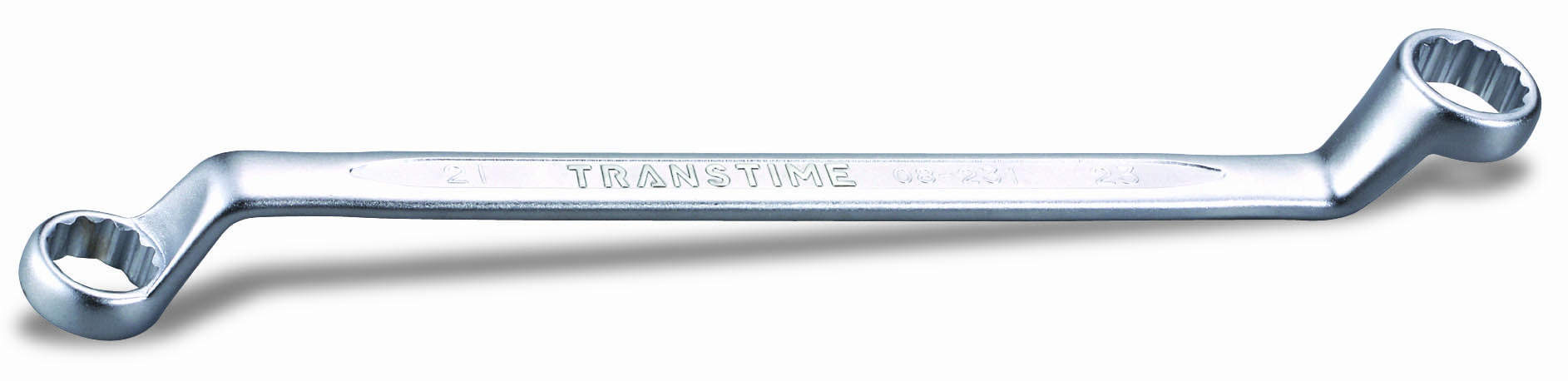
A half-moon wrench — also sold as an obstruction wrench — is a box-end (ring) wrench forged into a curved, crescent-like shape instead of a straight bar, with a wrench head at each end. The curve lets the tool's head swing past a housing, bracket, frame rail, or other obstruction that would stop a standard straight wrench from turning at all, which is why these wrenches exist for one job: reaching a bolt tucked in behind something else with almost no clearance to rotate a wrench around it. This guide covers why the curved shape matters, 6-point vs 12-point half-moon wrenches, and when you actually need one.
What is a half-moon / obstruction wrench?
Physically, a half-moon wrench is a double box-end wrench like any other, except the bar connecting the two heads is bent into an arc (a "half-moon", crescent, or offset "S" shape depending on the maker) rather than running straight. Both ends usually carry a standard ring/box profile sized for common fastener sizes, so the tool is used exactly like a normal box wrench — it is the body shape, not the head, that solves the access problem.
Why the curved shape matters
Every wrench needs room to swing before it must be lifted off, flipped, and reseated on the next set of flats. On a straight wrench, that swing arc is blocked as soon as the handle meets an obstruction — a bracket, a casting, or the engine block itself. Bending the body into a half-moon or offset shape increases the clearance around the head, buying a few extra degrees of swing before the handle contacts the obstruction — sometimes just enough to get one useful stroke where a straight wrench gets none at all.
6-point vs. 12-point half-moon wrenches
Because swing room is already at a premium in the spots these wrenches are used, many half-moon and obstruction wrenches use a 12-point head: a 12-point opening re-engages the fastener every 30 degrees of rotation, compared with 60 degrees for a 6-point head, so only half the swing arc is needed to reposition the wrench for the next bite. Where you may only get a small stroke before hitting metal, that difference can be what makes the job possible at all. A 6-point head grips more of the fastener's flats and resists rounding better, so it is sometimes chosen instead for stubborn or corroded fasteners where slipping is the bigger risk than swing room.
Construction: why the bend needs to be forged, not cast
The curved section carries the same twisting load as a straight wrench handle, concentrated around a bend instead of running in a straight line. Like other quality box wrenches, well-made half-moon and obstruction wrenches are drop-forged from alloy steel — chrome-vanadium is a common choice — rather than cast, so the grain of the steel follows the curve of the tool instead of being interrupted by it. A forged, correctly heat-treated wrench resists cracking or straightening out under load at the bend; a cast or under-specified tool is the one most likely to fail exactly where the curve is needed most.
Typical uses
Half-moon and obstruction wrenches are workshop and field tools for jobs where a bolt sits recessed behind a casting or bracket: starter motor mounting bolts, water pump bolts tucked behind a pulley or bracket, alternator and compressor mounts, and similar fasteners on engines, pumps, and heavy equipment. They see the most use on older vehicles, diesel engines, and industrial and agricultural equipment, where cramped bolt locations are common; on many modern passenger cars tighter engine bays have made them less of an everyday tool, but they remain essential whenever that one recessed bolt turns up.
Ratcheting half-moon wrenches
Ratcheting versions combine the curved body with a ratcheting box end, so the head can index the fastener in a few degrees of swing without being lifted off and reseated between strokes — useful on a bolt where even repositioning a plain wrench is awkward. Because the ratchet mechanism adds bulk to the head, a plain non-ratcheting half-moon wrench is still the better choice for the very tightest clearances.
Half-moon wrench vs. a standard offset wrench
A standard offset or cranked box wrench, like a double offset ring wrench, already lifts the handle up and away from the surface the fastener sits in, which helps with knuckle clearance and shallow recesses. A half-moon wrench solves a different, more extreme problem: not clearance above the fastener, but a solid obstruction in the plane the wrench needs to swing through. If an offset wrench gives you the reach you need, it is the simpler and cheaper tool to use; reach for a half-moon or obstruction wrench only when the swing itself, not just the approach to the fastener, is blocked.
When you actually need one
Reach for a half-moon or obstruction wrench only after a standard combination or box wrench, and a socket with a swivel or universal joint, have failed to reach or turn the fastener — most bolts don't need a specialty wrench, and a half-moon wrench's curved shape means it clears an obstruction only in the plane its curve is designed for. A small set covering the common sizes used on starters and water pumps is more useful in practice than a full range, since the shape is a solution for one specific class of recessed fastener rather than an everyday wrench.
Using a half-moon wrench safely
Because the swing arc is already tight, a half-moon wrench is more likely than a straight wrench to slip off the fastener mid-stroke if it is not seated squarely, so check that the head is fully engaged on the flats before applying force, and keep fingers clear of the path between the wrench and the surrounding obstruction. Where the bolt is seized, break it loose with steady pressure rather than a hammer blow on the handle — these tools are not designed to be struck like a slugging or striking wrench.
Source obstruction wrenches from the manufacturer
Transtime Tools forges box-end, open-end, and offset ring wrenches to metric and international standards. Browse our wrenches range for the profiles we carry as standard, and contact our team to discuss half-moon / obstruction wrench specifications and OEM/ODM production.